



Area of Law: Immigration Law
Answer # 6650
How do the new Express Entry high-wage points work?
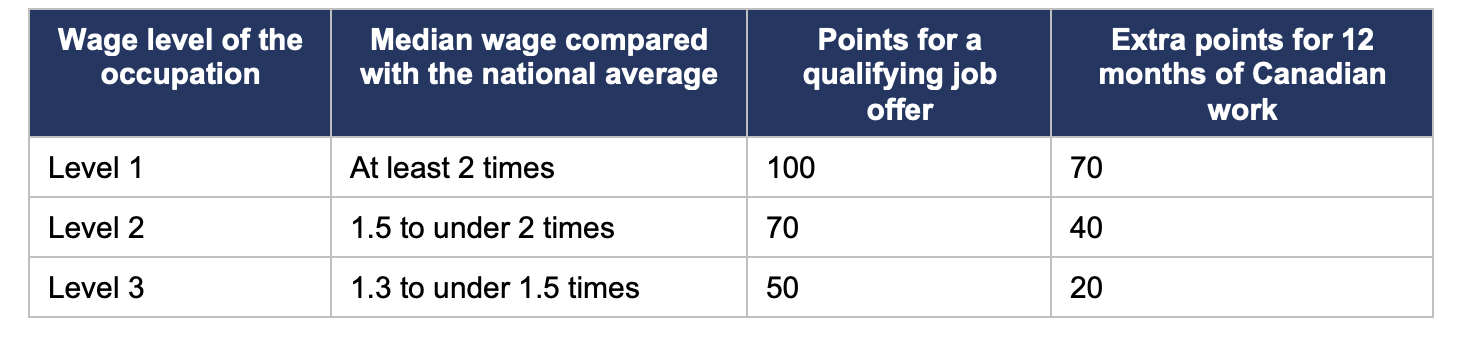
Region: Ontario Answer # 6650Since November 3, 2026, Express Entry gives extra Comprehensive Ranking System (CRS) points to candidates who have Canadian work experience or a job offer in a “high-wage occupation.” A qualifying job offer can now be worth up to 100 points, and at least one year of Canadian work in a high-wage occupation can add up to 70 points on top of the usual points for Canadian experience.
At the same time, Immigration, Refugees and Citizenship Canada (IRCC) removed the requirement for a Labour Market Impact Assessment (LMIA) for Express Entry job offers. These are the first of several reforms IRCC has said it will make to Express Entry, so it is important to check current rules before relying on them.
Key Facts
- In force: November 3, 2026.
- What counts: your occupation’s national median wage, based on its National Occupational Classification (NOC) code – not your own salary.
- Job offer points: 100, 70 or 50, depending on the occupation’s wage level.
- Canadian work experience points: an extra 70, 40 or 20 for at least 12 months in a high-wage occupation.
- No double counting: you receive either the job offer points or the work experience points, whichever is higher.
- No LMIA needed: an IRCC officer still checks that the job offer is genuine.
What is a high-wage occupation?
An occupation is “high-wage” if the median wage of everyone in Canada working in that NOC is at least 1.3 times the average median wage of the Canadian workforce. IRCC sorts these occupations into three levels using wage data from the last three years (the current list uses 2023 to 2025 data). Each occupation is placed at the highest level it reached during that period.
The list includes many managers, engineers, health professionals, technology workers, teachers and skilled tradespeople. IRCC publishes the official high-wage occupations list, and a searchable version of the list with the points for each NOC code makes it easier to check a single occupation.
How many points can you get?
How do the Canadian work experience points work?
Candidates continue to receive points for the length of their eligible Canadian work experience – up to 80 points for five years. If at least 12 months of that experience is in a high-wage occupation, extra points are added:
- 70 points for at least 12 months in one or more Level 1 occupations;
- 40 points for at least 12 months combined in Level 1 or Level 2 occupations; or
- 20 points for at least 12 months combined in any listed occupation.
Together, Canadian work experience can now be worth up to 150 points, or 140 points if your spouse or common-law partner is coming with you. The experience must generally be in a TEER 0, 1, 2 or 3 occupation and gained in Canada within the previous 10 years. Self-employment and work done while you were a full-time student generally do not count as eligible Canadian work experience.
What counts as a qualifying job offer?
A qualifying job offer must generally be in writing, recent, and for full-time (at least 30 hours a week), continuous, paid, non-seasonal work in Canada for at least one year after you become a permanent resident. It cannot come from an embassy, high commission or consulate. The offer may be from your current employer or a new one, and for an existing or a new position. Special rules apply to skilled trades and to physicians providing publicly funded medical services.
Can you get both job offer and work experience points?
No. If you qualify for both, IRCC gives you whichever option is worth more. For example:
- A software developer (NOC 21232, Level 2) with three years of Canadian experience receives 64 points for the three years plus 40 high-wage points, for 104 points. A job offer in the same occupation would be worth 70, so the work experience route applies.
- A financial manager living abroad (NOC 10010, Level 1) with no Canadian experience and a qualifying job offer receives 100 points.
- A candidate with two years of Canadian experience in an occupation that is not on the list keeps the 53 points for those two years, but receives no high-wage points.
These examples assume a single applicant. Extra points improve your rank in the pool but do not guarantee an invitation to apply – each round still has its own cut-off score and requirements. To estimate your CRS score under the new rules, enter your occupation, experience and any job offer.
Do you still need an LMIA for an Express Entry job offer?
No. Since November 3, 2026, an LMIA is not required for a job offer to earn the new points. A temporary public policy also exempts candidates invited on or after that date from LMIA requirements for job offers used to qualify under the Federal Skilled Worker Program and the Federal Skilled Trades Program. Having an LMIA does not earn extra points or priority.
Instead, an IRCC officer must be satisfied that the job offer is genuine, including that:
- the employer is actively engaged in the business making the offer;
- the offer reflects the employer’s reasonable employment needs;
- the employer can reasonably meet the terms of the offer;
- you are qualified and able to do the work, and likely to accept it; and
- the employer has complied with federal and provincial employment and recruitment laws.
A job offer that is revoked no longer qualifies. Until IRCC updates its online system, candidates with a job offer but no LMIA must follow the specific instructions on IRCC’s Express Entry job offer page when entering the offer in their profile.
What happens if the high-wage list changes?
IRCC will update the list as new wage data becomes available, so an occupation can move up or down a level or be removed. If the list changes after you receive an invitation to apply, IRCC keeps using the level that applied on the date you were invited.
What should you do now?
- Confirm your NOC code. Match your actual duties to the NOC description, not just your job title, and make sure your reference letters describe the same duties.
- Check the level of your occupation on the high-wage list.
- Update your profile. Existing profiles are recalculated automatically for Canadian work experience, but a job offer must be entered in your profile to be counted. IRCC paused invitation rounds for up to two weeks while it recalculates scores.
- Keep supporting documents ready for any job offer, including evidence that the employer’s business is active and can meet the terms of the offer.
Choosing a NOC code that does not match your real duties, or relying on a job offer that is not genuine, can lead to refusal and a finding of misrepresentation, which bars you from applying for five years. For how these changes apply in common situations – such as workers on intra-company transfers, provincial nominees and candidates outside Canada – see this scenario-by-scenario guide to the November 3 Express Entry changes.
Note: A criminal record will delay, and can even prevent you from getting your immigration status. To erase your criminal record, call toll-free 1-888-808-3628 or learn more at Pardon Partners. It’s easier than you think.
More Information and Legal Help
More information is available from IRCC: the backgrounder on the high-wage changes, the CRS criteria and the high-wage occupations list.
For personalized guidance on your Canadian immigration options and Express Entry strategy, contact our preferred immigration lawyer, Sobirovs Law Firm at 1-416-895-3026 or wecare@sobirovs.com. The Sobirovs team supports entrepreneurs, investors, and skilled professionals who want to build their future in Canada through clear, structured, and strategic pathways.




You now have options: